
Finance
OpenPay
28 January 2026
PayNow as easy as 1-2-3.
Find out more at the OpenPay demo website.
Opportunity - What the Research Showed
The team began with a simple question:
How can we make the PayNow experience even better than it is today?
Cards account for approximately 51% of Point-of-Sales (POS) transaction value
Digital payments (including PayNow) make up the next 35%
80% of consumers use contactless cards
≥50% of all age groups already use PayNow
Our conclusion: Adoption is not the issue, user friction is.
When you usePayNow at a stall / shop today, you go through the following steps:

Buying Online with PayNow can require even more steps:

The number of steps and their human time cost is a source of friction.
Hypothesis:
If PayNow was as easy as tapping your credit card on public buses, it would feel faster and easier. Reducing even 2–3 steps changes how speedy the PayNow flow feels.
Velocity — What We Built to Test the Hypothesis
We built a working Tap-to-PayNow prototype to demonstrate how the experience could be better.
PayNow in 3 Taps
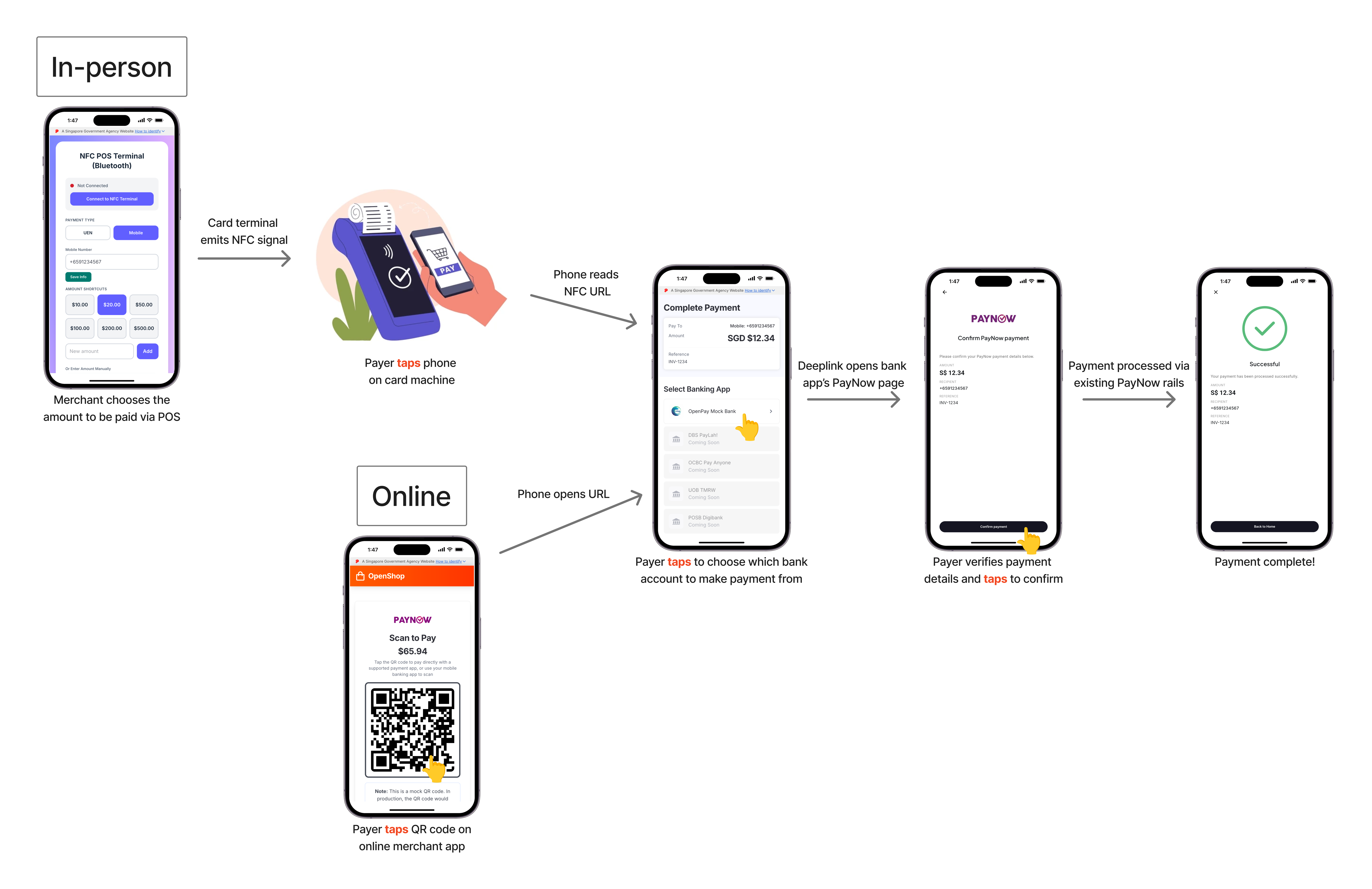
Tap your phone on a merchant device (in-person payments) or tap on a PayNow QR code (online payments)
Select a banking application to launch
Confirm the pre-filled PayNow details to complete payment
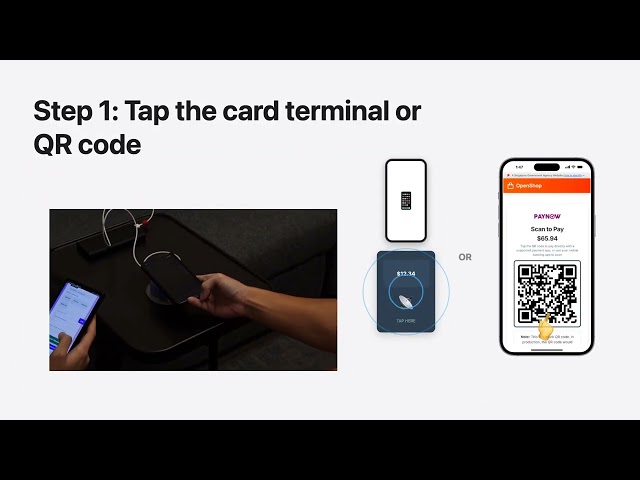
How It Works
The prototype relies on 2 key technologies to create a seamless payment experience.
Tapping your device on a merchant device - Near Field Communication (NFC)
Enables secure data transfer between your device and the merchant's device
This is the same technology that powers all contactless payments, including credit cards
Opening your banking application - Deep-linking
Allows websites to open specific pages in your mobile applications
This is already used widely today in various applications, from Singpass logins on mobile devices to opening items in e-commerce applications
Traction — What We Observed
At Demo Day:
Public officers and engineers tested the tap-to-pay flow live
Users consistently completed payments in fewer visible steps than QR flows
Strong qualitative feedback:
“Feels like tapping my card.”
“Why isn’t this already how PayNow works?”
“Much easier than switching apps and scanning.”
The prototype validated two research insights:
Singaporeans already understand tap-to-pay behaviour.
The usability gap between cards and PayNow can be significant and discernible.
Moving forward the team is keen to:
Continue user research focusing on improving ease and speed of the PayNow experience, which drive adoption and inclusion.
Even small time savings at transaction level compound nationally.
Suggest research-backed UX improvements to PayNow, with studies comparing the PayNow experience to international products (UPI Intents, Pix tap-to-pay)
OpenPay is a research prototype demonstrating that PayNow can feel as simple as tapping your credit card.
The team

(Left to right) Gaille, Gerald, Geraldine, Harsh, Justin, Justyn, Mahirah, Zong Han
The team simultaneously worked on CouponSG during HFPG 2026.
Credits to Daniel Sim for the images used above.