
Social & Community
Social Passport
30 January 2026
A client-owned digital passport that travels with them between care providers, giving workers instant context and clients control over who sees their information.
Opportunity
Every transition means starting over.
When vulnerable individuals in Singapore move between care providers—from a Family Service Centre to a mental health provider, then to financial assistance—their care fragments at every handoff. We spoke with social workers across hospitals (NUH), community agencies (SAMH, SHINE), prison reintegration (ISCOS), and schools who all confirmed the same pattern: clients bear the coordination burden.
What clients experience: Retelling their trauma at every new agency, navigating services alone with no visibility into who else is involved, and juggling information across multiple workers.
What workers experience: Starting from zero to reconstruct a client's history, spending sessions on repetitive intake instead of support, and coordinating without knowing who else is helping.
A teacher we interviewed said: "There's a lot of messiness—hard to find people, hard to get info. A lot of information gets lost."
Why this happens: Records are agency-bound. Each organisation keeps its own files, and client history stays behind when they move. Cross-agency sharing requires formal agreements, and integration between dozens of systems doesn't scale.
Why it matters: Data sharing isn't just a client issue—it's a workforce sustainability issue. When professionals spend time reconstructing history instead of providing support, both clients and workers lose.
What client sees
What care provider sees
Velocity
We built a working prototype of Social Passport—a client-carried digital record that travels with them across services.
What users can now do:
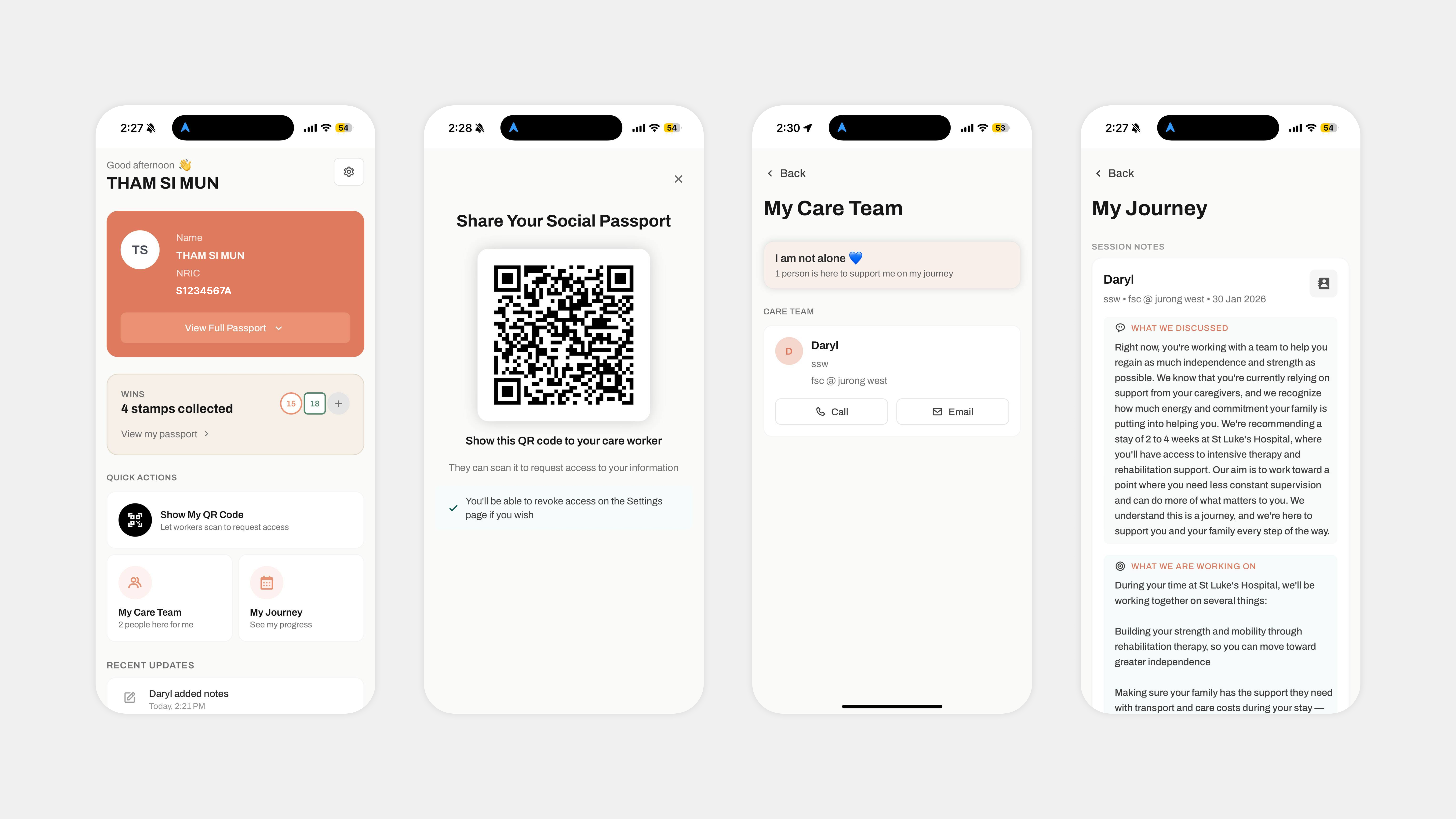
Clients authenticate via Singpass, share access via QR code, grant or revoke worker access anytime, and see a full audit trail of who accessed their passport
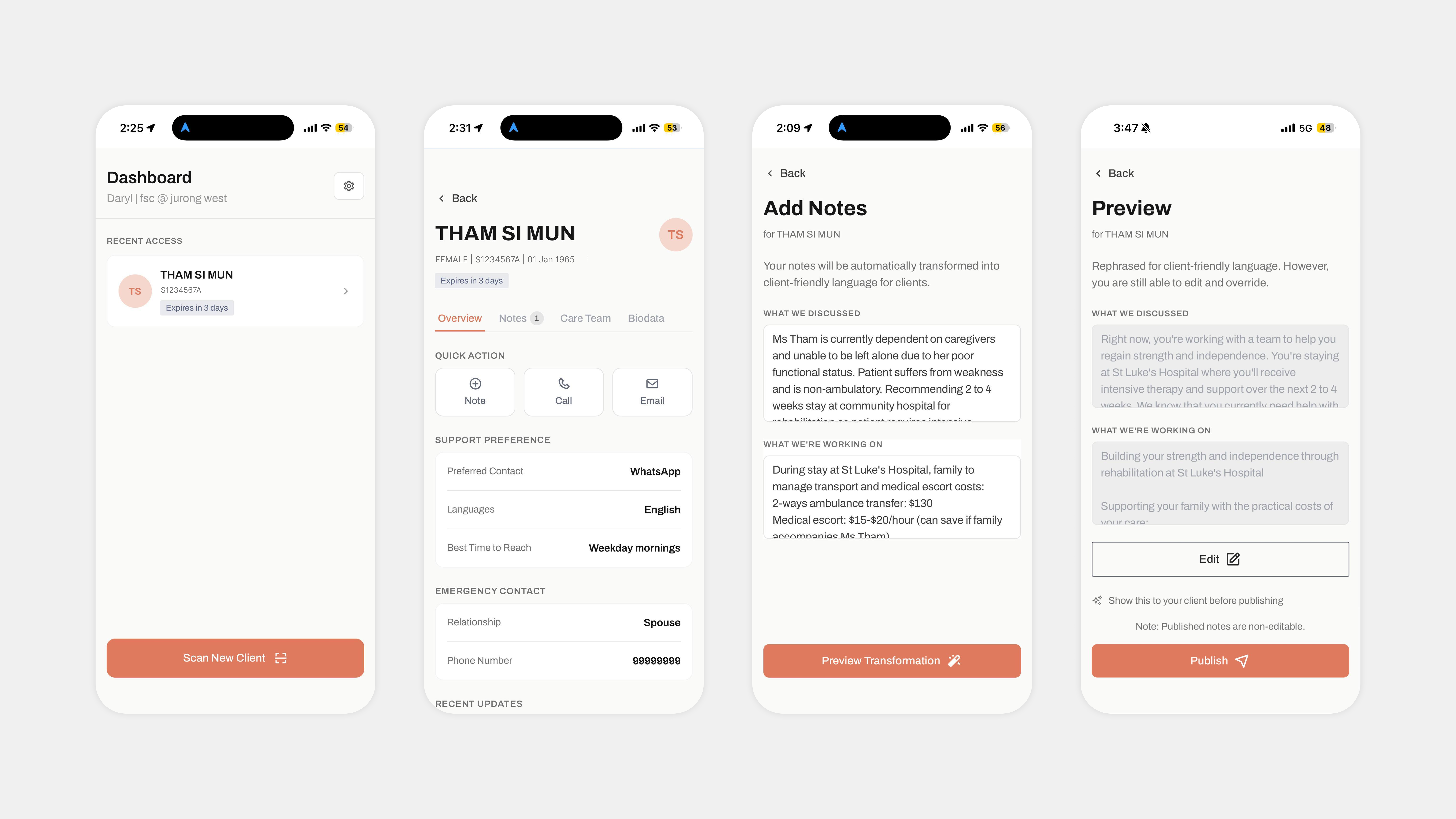
Workers scan a client's QR to see who else is involved, what's been worked on, and add notes that AI transforms into client-friendly language
Why AI transformation matters:
Social workers write notes in clinical language—focused on problems, deficits, and medical terms. But Social Passport is for clients to read. The AI transforms notes by shifting from "talking about the client" to "talking with the client," replacing jargon with simple words, and reframing deficits as strengths—while keeping all important details intact.
Before: "Mr Koo is at contact guard assistance and cannot be left alone."
After: "We've discussed the support you need right now—you're working towards being more independent after rehab."
Key features shipped: Singpass authentication, QR-based access sharing, AI-powered note transformation, care team visibility, and activity transparency.
Current limitations: No family proxy access yet, no attachments or scheme info, no multilingual support, and no selective note hiding.
Traction
Who we spoke with:
Discovery interviews: Social workers at SAMH and SHINE, prison reintegration SW at ISCOS, secondary school teachers
User testing: 15 senior Medical Social Workers at NUH
What we observed:
Almost all 15 MSWs could imagine using Social Passport in some way. Workers who already practice client-centred care immediately identified use cases: "Sessions where a lot of information is shared, I could imagine putting it in Social Passport and asking the patient to digest the information."
Other workers saw it as a transactional tool replacing email—showing we need clearer messaging about the continuity benefit.
What workers said about the problem:
SHINE YIT team lead: "We try not to ask the youth to retell their story as it can be traumatising"
Prison SW noted 80% of clients threw away the physical "Reintegration Passport"—highlighting why digital and client-controlled matters
Early interest: SHINE expressed interest in follow-up testing. Teachers identified school counsellor shortage as a key driver. NUH MSWs willing to continue engagement.
What needs to happen for adoption: Workers need to see this as reducing work, not adding a system. Clients need to feel empowered, not burdened.
Team
Lai Jing Yi
Tham Si Mun
Daryl Chan
Benjamin Png