
Healthcare
SafePlate
30 January 2026
Another check before you pick where to eat. Search Singapore's 39,000+ food establishments for hygiene grades, demerit points, and suspension records, before you decide where to eat.
Source Code: https://github.com/hfpg2026/safeplate
Team: Priyank Chaudhary, Qilu Xie
Opportunity — What problem are we solving, and why it matters
The Problem
Every year, SFA inspects 39,000+ food establishments across Singapore. They record hygiene grades, demerit points, and suspension histories. This data could help residents make safer dining choices — but almost nobody can access it.
The data exists as a GeoJSON file on data.gov.sg. There is no search portal. No mobile app. No way for a resident to check a hawker stall's safety record before ordering.
Who Experiences This
Elderly residents — Singapore becomes a super-aged society by 2030, with 1 in 4 residents over 65. For Pioneer and Merdeka generations, food poisoning isn't just discomfort — it's a hospital visit.
Parents with young children — checking food safety before a birthday party or family gathering.
Tourists and new residents — unfamiliar with local establishments, relying on reviews that measure taste, not safety.
Everyone eating out — Singapore has ~7 food establishments per 1,000 people. We eat out constantly. We deserve to know what we're eating.
What We Learned
We surveyed 19 Singapore residents. The findings:
Finding: 0 out of 19 knew the A/B/C/D grading system existed
Implication: Total communication failure
Finding: Those who knew couldn't explain what "Grade B" means
Implication: Letter grades aren't intuitive
Finding: SFA's planned QR codes aren't noticeable
Implication: Visual clutter in food establishments
-> This isn't a data problem. It's a last-mile delivery problem. The inspections happen. The data exists. But citizens can't use it.
Why It Matters
Public health: Informed choices reduce foodborne illness, especially among vulnerable populations.
Accountability: Citizens paid for these inspections. They deserve to see the results.
Hawker culture: Singapore's hawker heritage is UNESCO-listed. Trust in local food safety protects that heritage.
What We Shipped
A fully functional search portal that makes SFA's food safety data accessible to every resident.
Core Features
Fuzzy Search Find establishments by name, address, or postal code — typos forgiven
Interactive Map See grade-colored markers across Singapore, pan to explore areas
Suspension Alerts 80 suspended establishments flagged with pulsing warning indicators
Grade Filters Show only Grade A, or toggle to see suspended-only
Mobile-First Works on any device, no app download required
What a User Can Do Now (That They Couldn't Before)
Type "Tampines" and instantly see every food establishment's hygiene grade
Filter to Grade A only — find the safest options in any neighbourhood
See suspension history before deciding to eat somewhere
Tap through to Google Maps for directions
What Still Needs Work
Real-time data sync
Status: Currently processing static GeoJSON; need API from SFA
Emoji label pilot
Status: Recommended system not yet tested in field
Multilingual UI
Status: Interface in English only; labels work across languages
User accounts
Status: No favourites or history yet
What We Tried That Didn't Work
Initial map load with all 39,000 markers — browser crashed. Switched to bounds-based loading with limits (15 desktop, 8 mobile).
Letter grade explanations in tooltips — users ignored them. Emojis communicate faster than text.
Traction — Early validation and what happens next
Who Used It
19 survey respondents — validated the problem (zero awareness of grading system)
Internal testing — team members used it to check establishments before actual meals
Hackathon demo audience — [to be updated after presentation]
What Users Said
"I've been eating at [establishment] for years. I had no idea they had demerit points." — Survey respondent
"Why doesn't SFA have something like this already?" — Internal tester
Evidence This Works Elsewhere
Denmark (Smiley scheme, 2001)
Outcome: "Virtually all consumers know it"
King County, USA (Emoji labels, 2017)
Outcome: Tested in 8 languages, 3,800 survey responses
UK (FHRS 5-star)
Outcome: Mandatory display in Wales increased compliance
King County's research is directly applicable to Singapore:
Tested across Chinese, Vietnamese, Korean, Somali speakers
Found emojis + descriptive labels outperform letter grades
4-year development with community input
What We're Asking For
1. Endorsement
Why: Link from sfa.gov.sg gives legitimacy
Effort: Low — one hyperlink
2. Data API
Why: Real-time sync instead of static file
Effort: Medium — SFA engineering
3. Pilot
Why: Test emoji labels at one hawker centre
Effort: Medium — signage + survey
Potential Impact (If Scaled)
Grade awareness
Target: 0% → 60%
Measurement: Follow-up survey
Monthly active users
Target: 10,000+
Measurement: Analytics
SFA inquiry reduction
Target: -30%
Measurement: Call centre volume
Establishments improving grades
Target: Track YoY
Measurement: SFA data
Screenshots
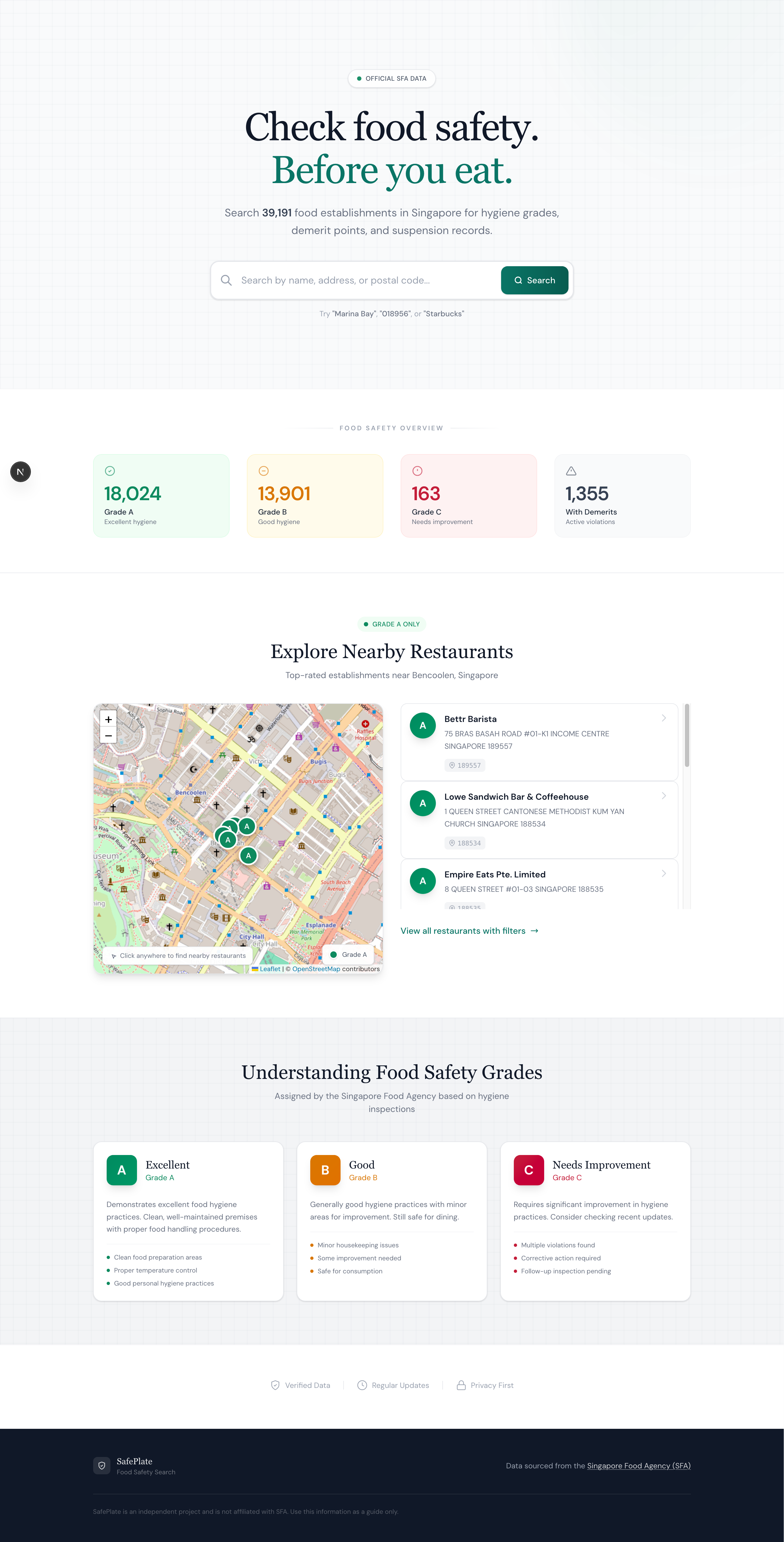
Safeplate landing page search bar supporting semantic search
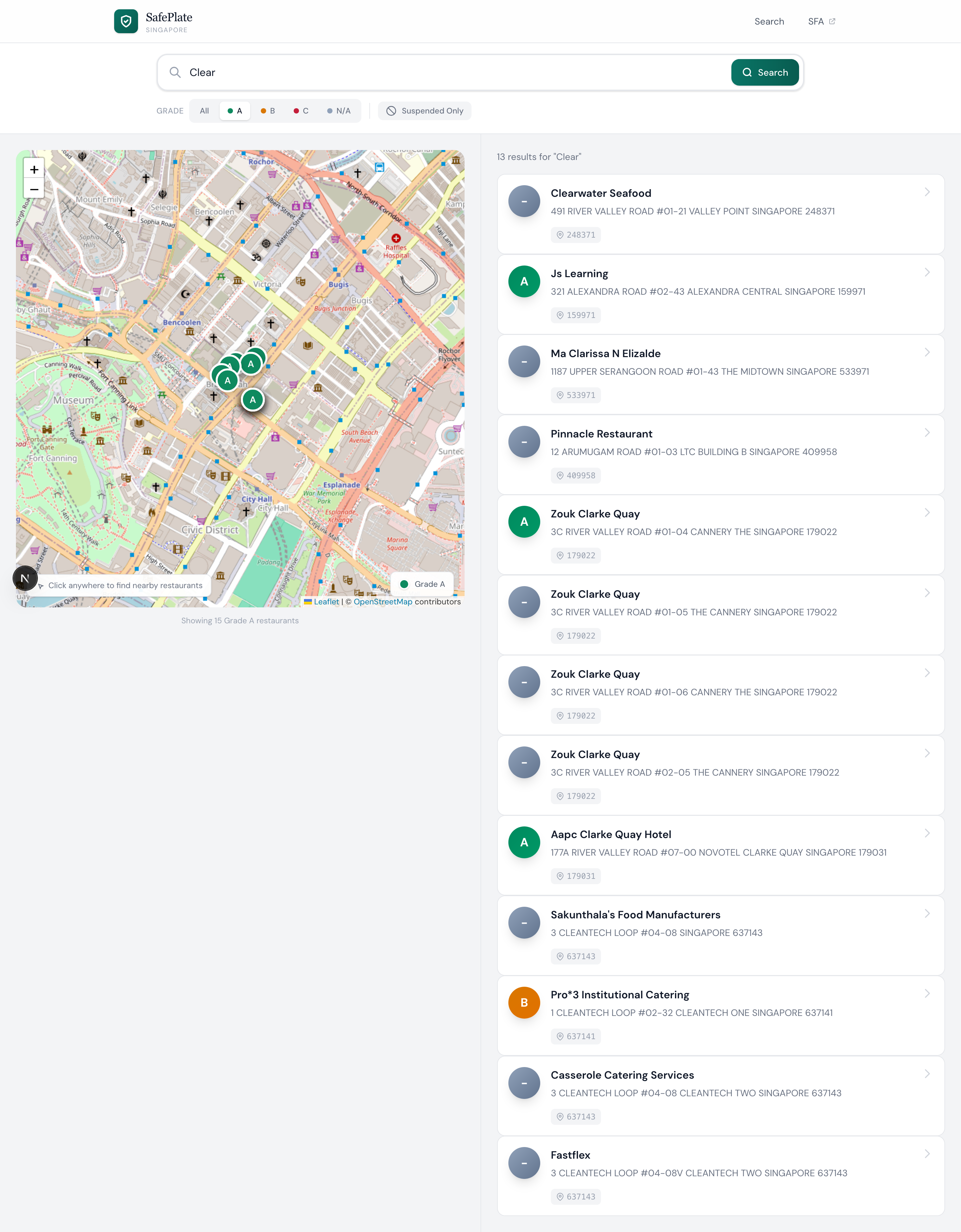
Search results and filtering view
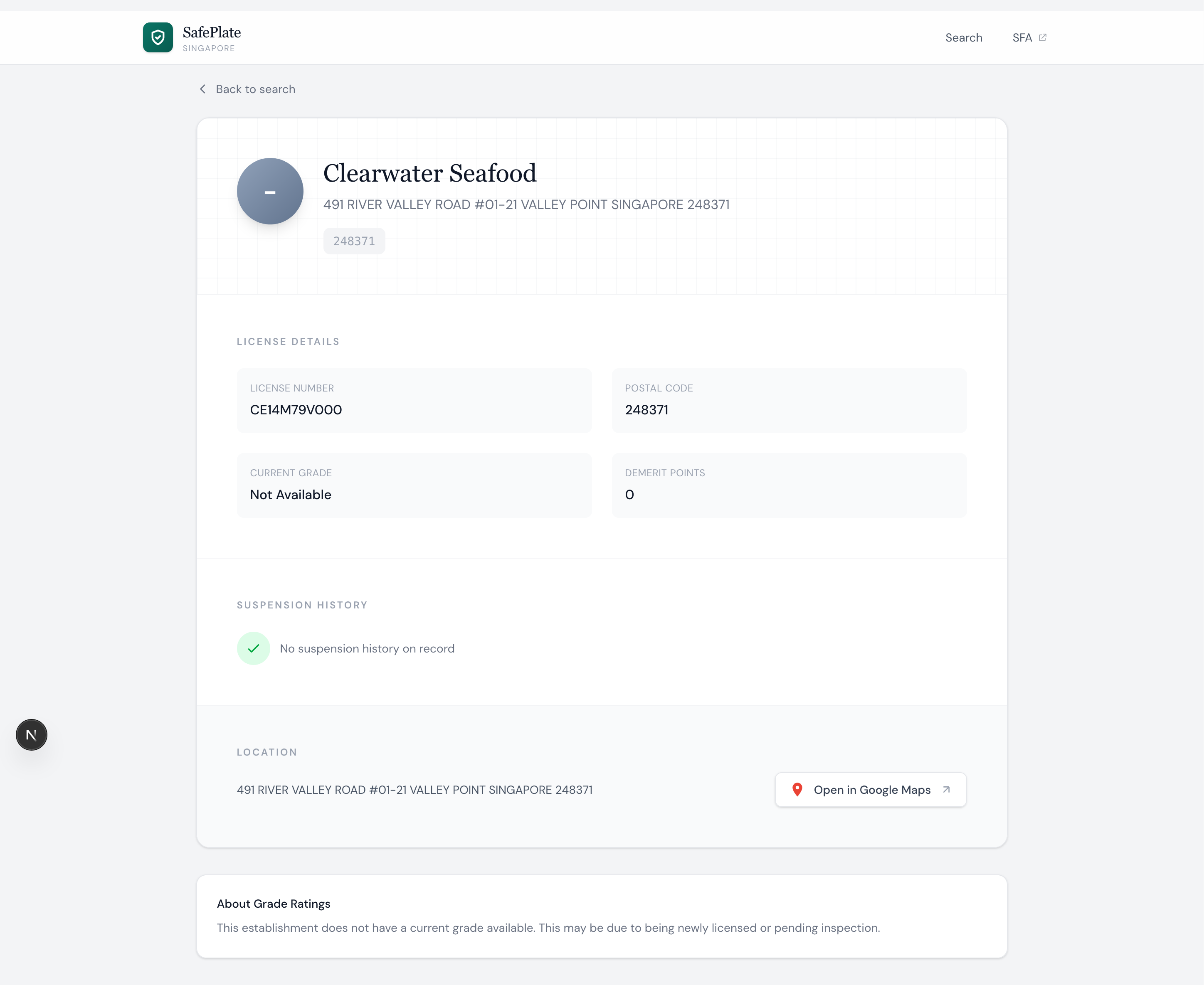
Restaurant food safety profile view with links
SafePlate is an independent project built during HFPG Hackathon 2026. It is not affiliated with the Singapore Food Agency.