
Tooling & Productivity
ForumSG
28 January 2026
A forum-based discussion platform for admins to get operations support
https://forumsg.hack2026.gov.sg/
The Opportunity
Problem: scalable product operations
Product operation teams spend a significant amount of time providing quality support. Especially for OGP platform products, admins often write in with complex, high-context questions which require time and effort to understand their particular use-case and craft an accurate response. Furthermore, existing support channels do not keep a persistent, searchable record of solutions, which can limit the multiplicable value of crafted solutions and also result in repetitive, recurring similar questions asked over time. This ultimately does not encourage scalable operations support that is important for lean product teams to operate efficiently.
FormSG receives ~10 of these a week (relating to workflows, school-specific digitisation processes, approvals etc.) which take on average ~30mins each to respond to. The FormSG product operations team of 5 supports a 236,193 active user group— The FormSG team
Solution: The ForumSG experiment
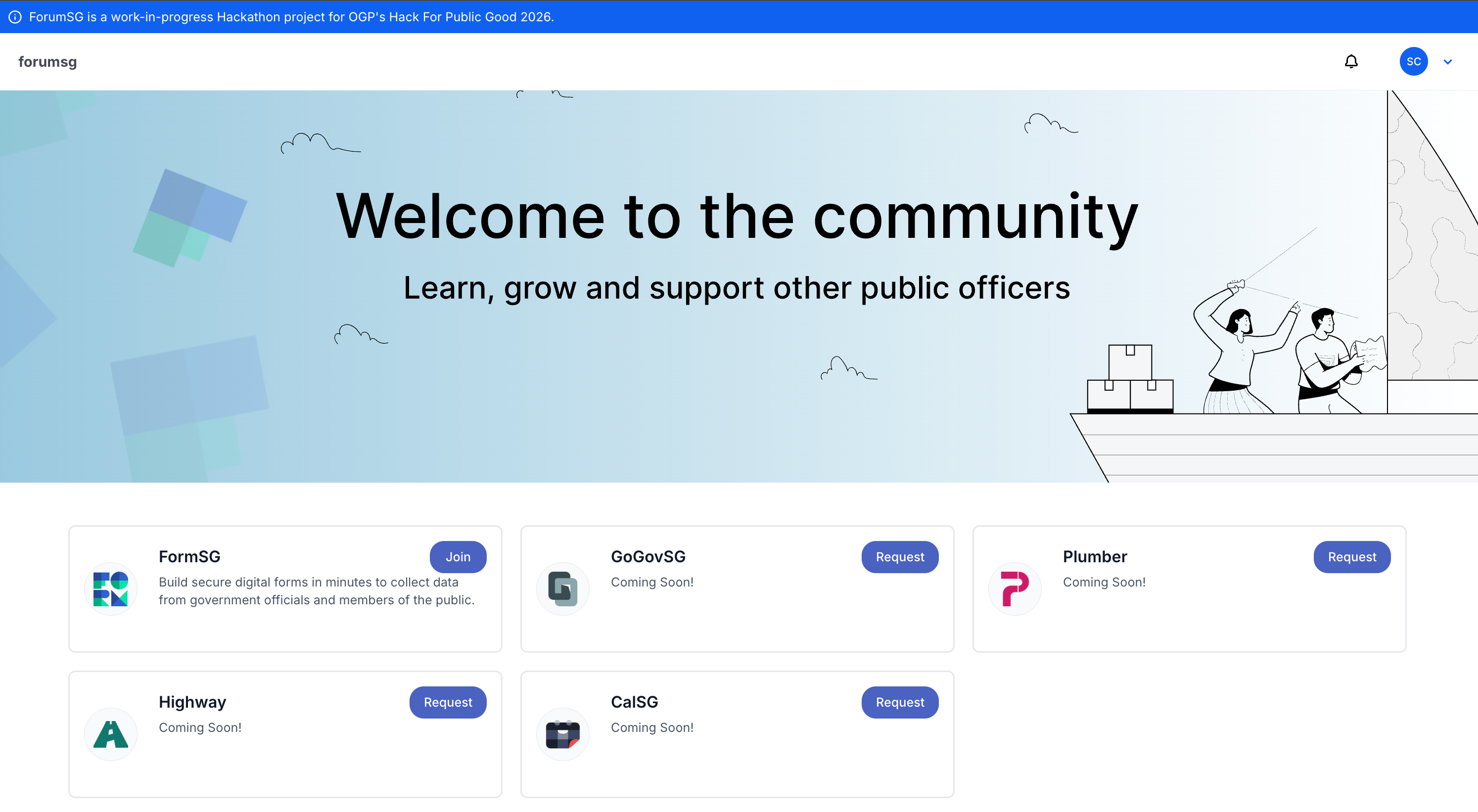
ForumSG is an experimental product aiming to solve the problem of scalable operations support by providing a community space where public officers can find, share and discuss solutions.
What will the forum try to solve?
Offload product ops support by encourage peer-to-peer support
Keep an organized, searchable history of solutions to reduce repetitive contextual questions
The hypothesis is that a forum will reduce the effort product ops spend crafting repetitive or context-heavy solutions and reduce the time it takes for users to receive answers to their questions, and provide an opportunity for the community to help each other.
The Velocity
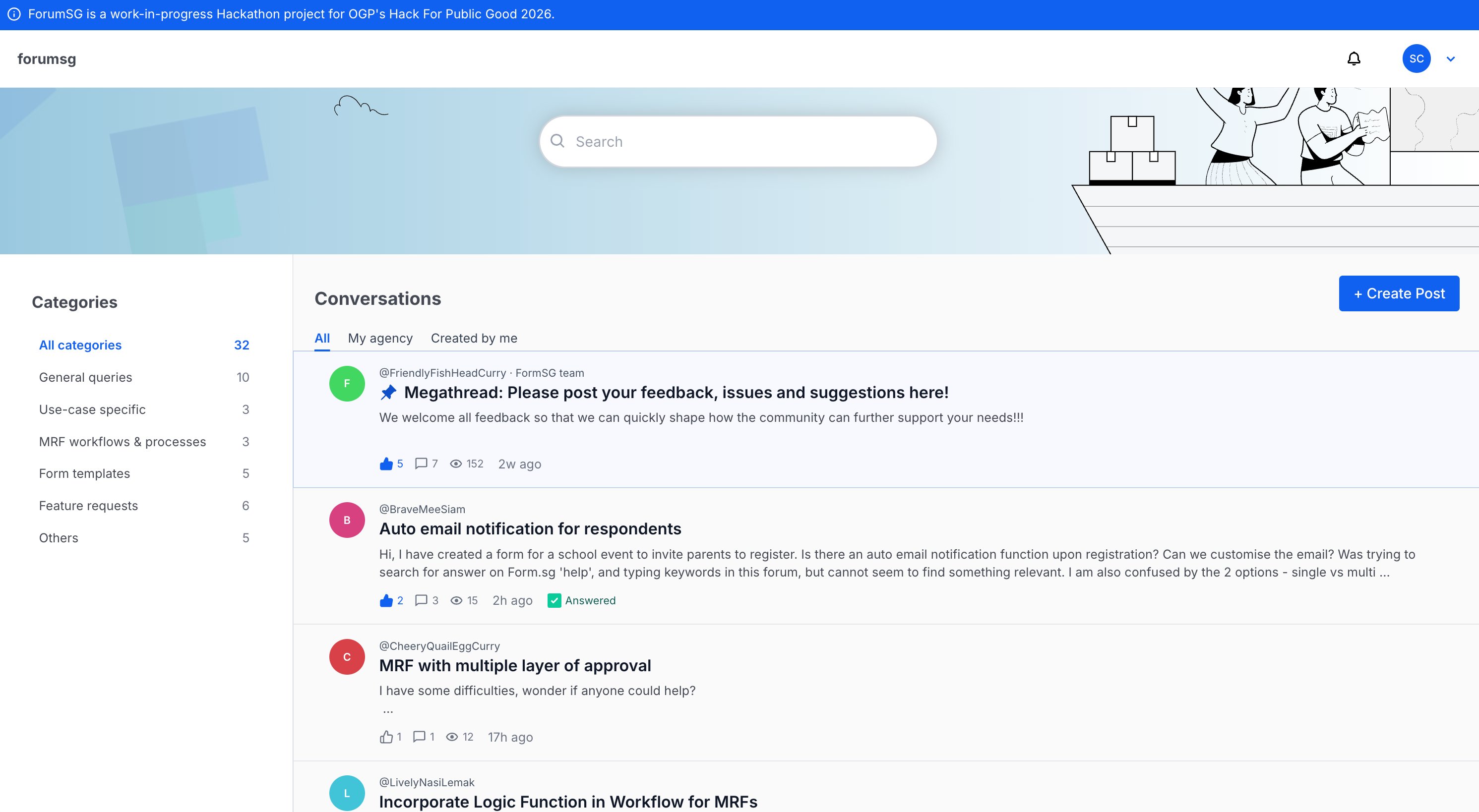
ForumSG serves as a community-based discussion platform organised around communities and conversations. Users can join communities, post conversations (questions or discussions), and subsequently engage in conversations through likes and replies. Conversations are searchable within communities (through a search bar) and can be marked as ‘Answered’ to easily inform users that a verified solution exists to the posed problem.
Our initial release to market started with 1 community (FormSG x MOE), aligned with FormSG’s drive to digitalize school paper processes where they experienced these pain points of handling repetitive high-context questions across digitizing similar workflows like bus booking and incident reporting. This also took into consideration the capacity of the team not to overstretch by supporting multiple communities and contexts.
The team had a meaningful time figuring out certain parameters for the product, making decisions through a calculated balance of assumptions and validations through conducting a total of 9 user interviews and usability tests.
Anonymity
Should we show user emails in conversations and replies?
UTs and feedback garnered mixed responses. On one hand, people felt less hesitant to make posts under the cover of anonymity. However, anonymity would increase the barrier if someone wanted to respond or follow-up directly to another person’s reply.
We decided to go instead with usernames - auto-generated anonymous names that were tagged to the user. On the BE, the team would still be able to know who posted the content for security purposes, while on the FE users would be able to know who they were communicating with. We went with playful, local food-based usernames like @FriendlyFishHeadCurry or @TinyBananaBread. This was received positively with our users!
Upvotes and/or downvotes
The team decided to only allow the action of upvoting, since knowing that a post wasn’t helpful would be deduced from having a lack of upvotes. However, initial feedback was negative - users were confused with the purpose of upvotes and its implications.
We decided to replace the action of upvotes with thumbs up 👍, which was more understandable and align with well-used conventions (like Youtube, X, Facebook)
Iterative research and development
User journey - A search bar

We learnt that users would come onto ForumSG either:
They have a specific question they want answered
They are trying to figure out how to do something, or if something is allowed.
This led us to priortise building a search bar to support this primary flow. We also observed how people would search for questions in the search bar if they typed using keywords or natural-language sentences.
Engineering effort was invested into experiementing with different types of searches.
1. Keyword text search
2. Semantic search
3. Auto-complete search
4. Instant live search (result update as user types)
5. Search on enter
Our search bar incorporated a combination of semantic and instant live search. Takeaways were that keyword-text search were either too general or specific with the need to handle ‘non-keywords’. Semantic search on the other hand added an additonal engineering step of creating vector embeddings per post, but would derive more relevant search results.
ForumSG entrypoint + SSO

We decided early on that an entrypoint into ForumSG was on FormSG (a user having trouble building a form would look for the forum there). Since ForumSG required authentication so as to keep a BE record of user information for posts, single sign-on (SSO) was a potential opportunity to ease the friction navigating between FormSG and ForumSG.
SSO was ultimately de-prioritised after scoping the time and effort it would take to implement. It is however still deemed as a unlanded opportunity which we are confident in improving the user experience in entering ForumSG. The alternative solution implemented was to increase the number of entrypoints into ForumSG: (1) Adding a link on FormSG guide (guide.form.gov.sg) and providing direct ForumSG links in our propagations through telegram and postman blasts.
Notifications

Another key concern users surfaced were how easily and quickly would they know if their questions were answered. We determined that it was crucial to implement ‘push’-based actions to inform the users of these updates, rather than relying on ‘pull’-based actions (requiring them to stay on the platform and track the conversation updates themselves).
2 notification features were implemented on ForumSG:
1) A notification bell component that would show a red indicator upon new replies to a user’s posted thread and a dropdown inbox containing these messages
2) An email would be sent to the user when someone replied to their thread
Propagation
Our propagation strategy consisted of a total of:
Propagation numbers
Type | Count |
Usability tests | 6 users |
School engagements | 8 schools |
Postman email blast | 1x mail (11k users) |
Telegram message blast | 1x message |
The Traction
ForumSG received decent traction over iterative propagation. Although a significant number of users logged in, user activity was not frequent, alluding to most users being passive consumers of the platform.
4 weeks of ForumSG activity
Metrics | 15 Jan 2026 (First launch) | 29 Jan 2026 |
|---|---|---|
No. of clicks from FormSG main entrypoint | 84 | 1130 |
No. of users (login) | 25 | 315 |
No. of user posts | 3 | 16 |
No. of user replies | 2 | 56 |
% of user activity on platform | 20.00% | 10.16% |
* where user activity = no. of organic posts + no. of organic replies
ForumSG did however receive positive feedback about its potential and interest in the community, which was encouraging.
Forum woudl be a more organized way of posting queries and suggestions, and makes archiving and referring easier. Formies is bette rat informal chatter and quick checks. They both ahve their pros and cons, but overall it would be good to have both.— Farhan
As an early adopter, I'm keen to help figure out how this platform can best serve our nursing community's needs. I think it could really strengthen connections between nurses in different PHI settings and ultimately improve how we support each other professionally. The opportunity to build a knowledge-sharing network that goes beyond individual institution boundaries is what makes ForumSG particularly interesting to me.— Ashraf
What's Next?
Introduce the concept of roles and verified users - community experts that can serve as moderators, determine the validity of solutions, drive active membership, conversations and engagements.
Expand the types of communities:
Onboard other products with active communities to have create their own forums (maybe plumber, isomer, pair etc.)
Explore agency-based communities on top of product-based communities, and introduce the concept of private & public communities
Introduce global, community-agnostic search
The Team

Organic community engagement cannot be engineered— Scott
What stood out from research: anonymity isn’t a clear win either way — preferences are split between “anonymous by default” vs “show real identity”. Also, while the random food nickname pairing was a fun direction, we surfaced a risk where certain foods can be culturally insensitive. On access: we initially assumed SSO would be a key unlock, but deprioritised it to ship core forum features first. The bigger insight is that many Form admins are curious to explore, but not motivated to log in just to browse. That’s different from FormSG where login friction is acceptable because they’re there to complete a task. Since we can’t make threads public like Reddit, we’ll need a more creative “low-friction preview” approach within our access constraints.— Kenneth