
Social & Community
Donatello
30 January 2026
Exploring easier CDC Voucher donations to those in need. This prototype is purely exploratory and not ready for launch yet.

The Problem & Why It Matters
Background
Since 2021, members of public like you can pledge your expired CDC vouchers to trusted, publicly accountable charities (known as Institutes of Public Character, or IPCs). This arose from public feedback from Singapore households who wanted to share their vouchers with those in need.
Key Pain Points
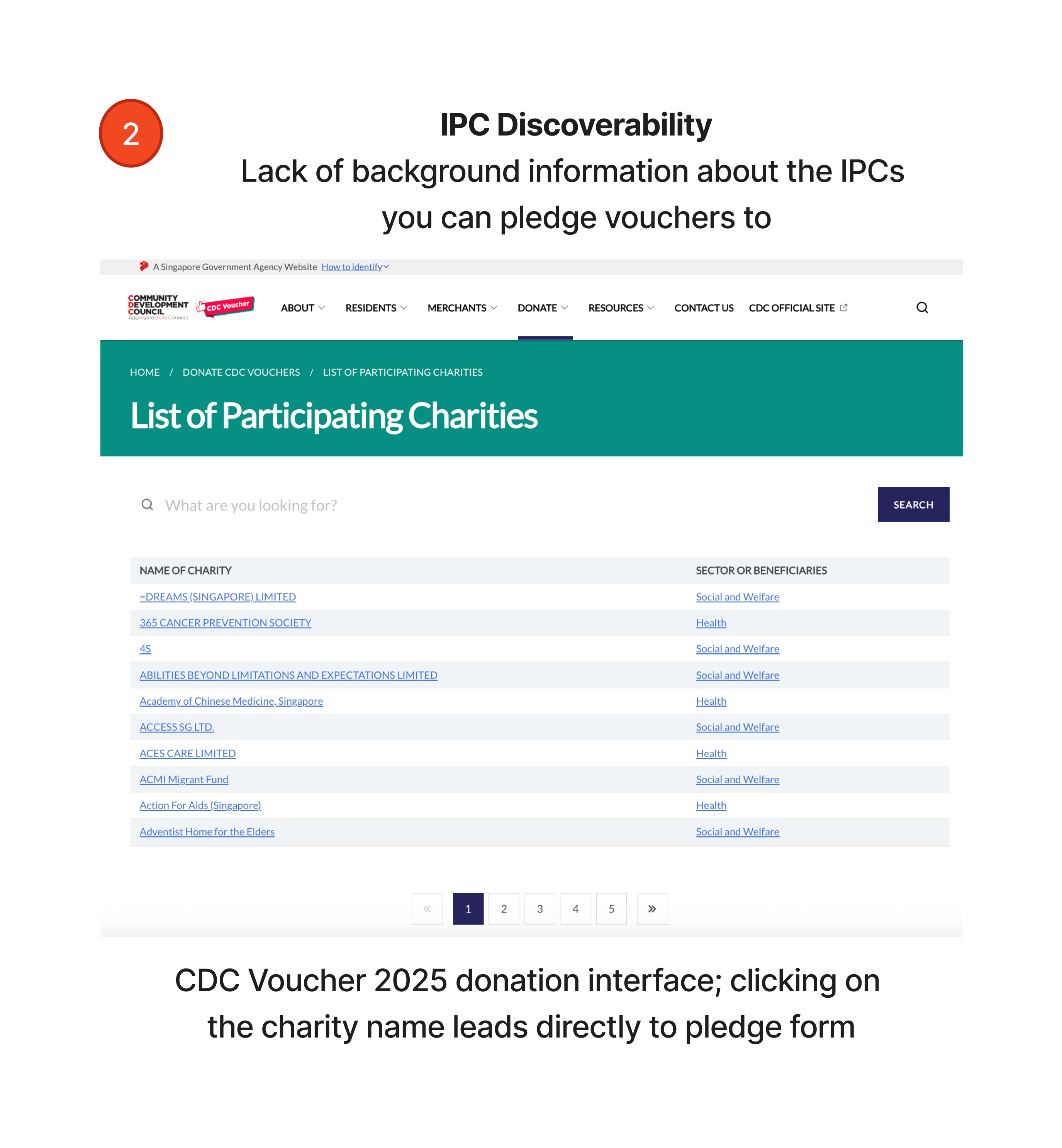
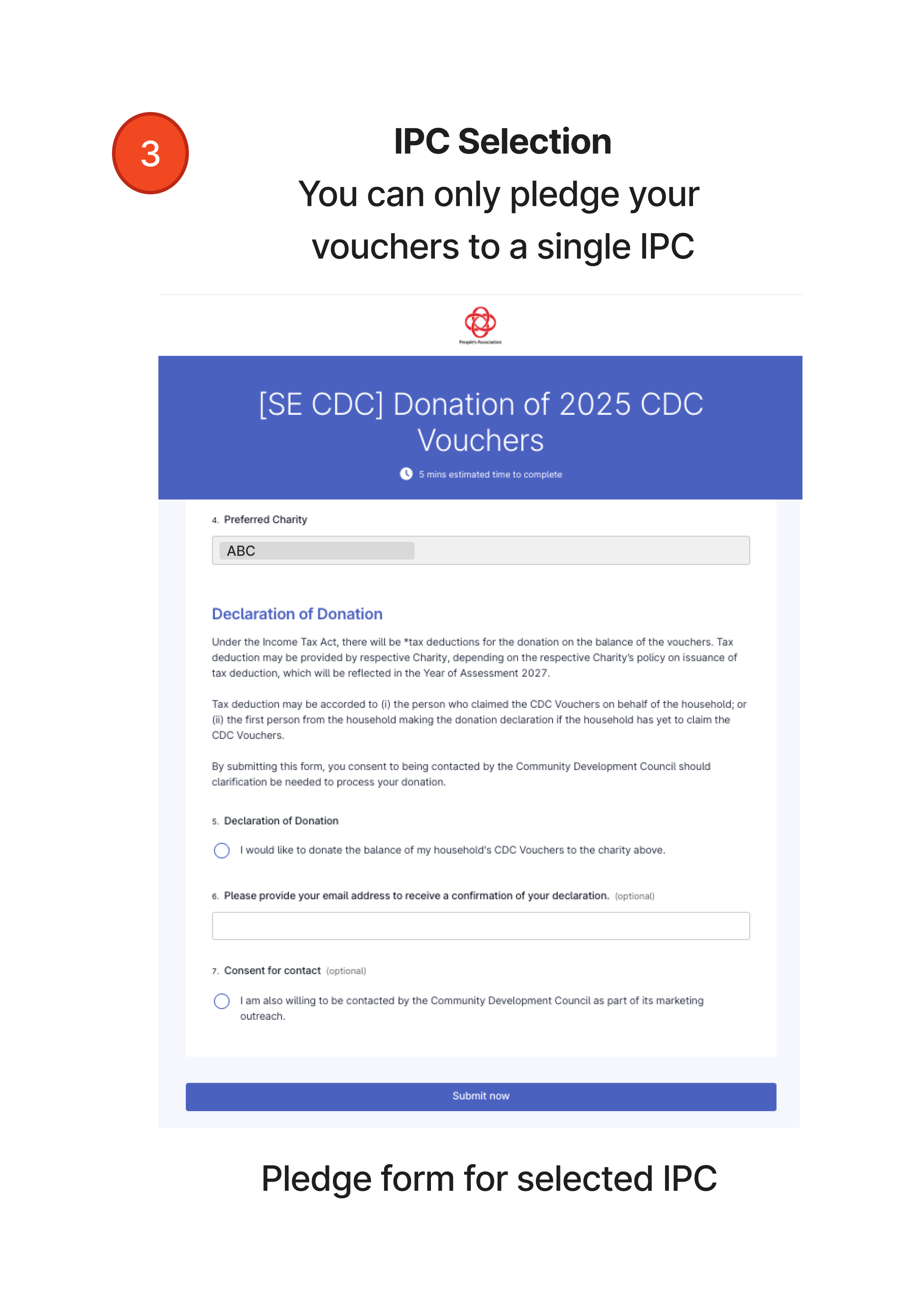
Pain Point 1 - Pledging Mechanism
The current process only allows you to pledge expired vouchers to your chosen IPC. At the end of each campaign (e.g. after 31 Dec 2026 for the ongoing January CDC campaign), checks will be performed to see if you have any expired vouchers. That balance, if any, will be donated.
Pain Point 2 - IPC Discoverability
Unless you already know the IPC you’d like to donate to, the existing interface makes it challenging to find out about what the IPC does before you’re asked to pledge your vouchers. You’ll have to separately search up the IPC to understand the causes they serve and the work they do.
Pain Point 3 - IPC Selection
You can only pledge your vouchers to a single IPC, though you may be interested to support more than one.
Pain Point 4 - Operational Load for PA
If you pledged your vouchers today, someone from the People’s Association (PA) would have to manually process your pledge before transferring the monies to each IPC. There are 400+ participating IPCs to-date.
The burden on PA to facilitate this good cause is disproportionate. In 2021-22 alone, PA staff had to manually process the pledged vouchers from nearly 10,000 households worth $1.2 million in value.
The volume of voucher donations, and hence the operational load of facilitating these donations, may be much higher for PA. Compared to the $200 in CDC vouchers given to each household in 2021-2022, the scale of the 2026 campaigns is much larger—on top of $300 in January CDC vouchers for each household, there are also $600 in SG60 Vouchers for Adults and $800 in SG60 Vouchers for Seniors. This represents S$2.41 billion in vouchers in 2026, about 10 times larger than the S$252 million in vouchers disbursed across 2021-2022.
What We've Built
Try it out here!
Disclaimer: This is just an exploratory hackathon project. There are no current plans to launch this platform.
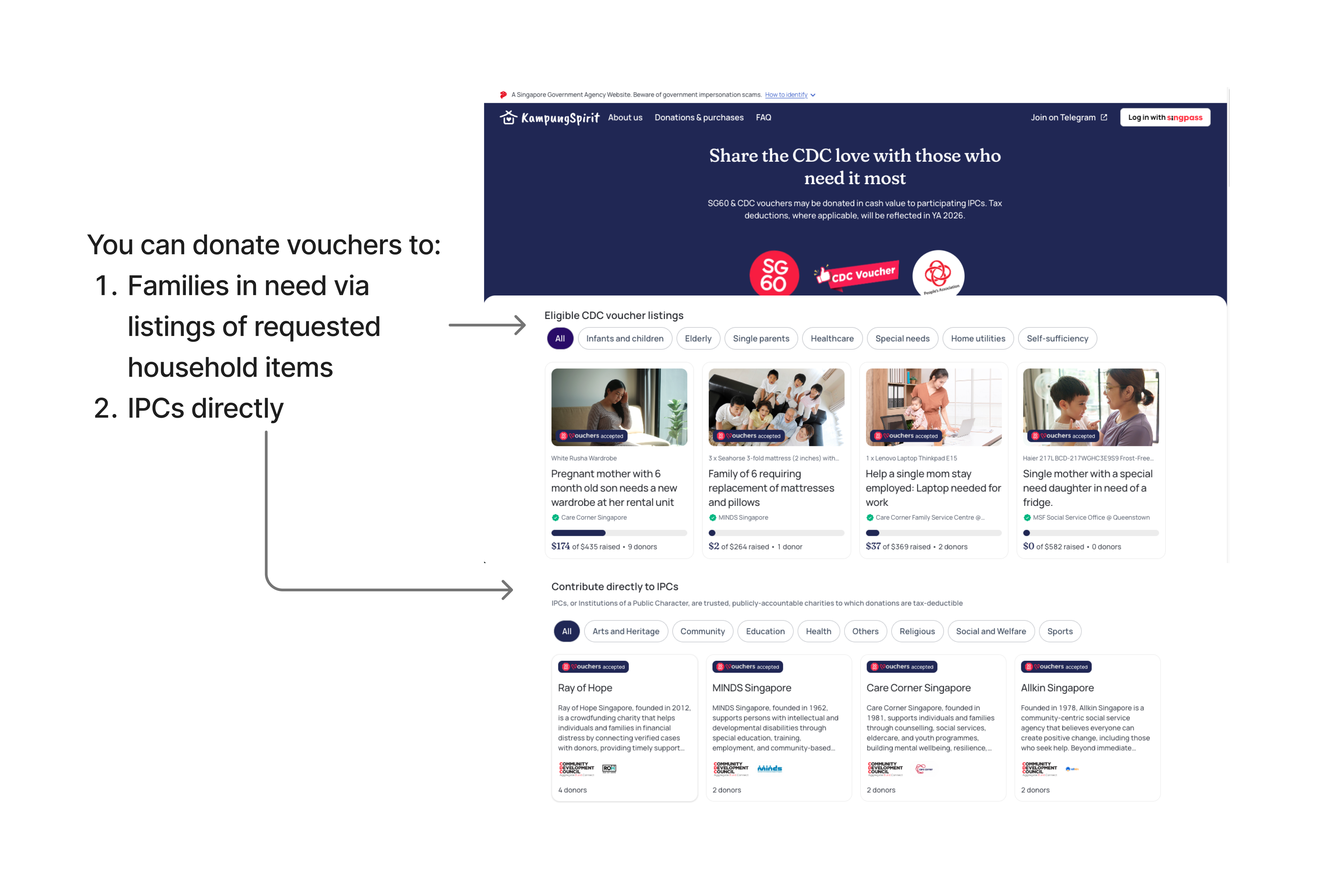
KampungSpirit landing page for CDC Voucher donations

Checkout page for CDC voucher donations
Improved donor experience
New landing page on the existing KampungSpirit platform, directing you to IPCs and listings that accept vouchers instead of cash
Donate your vouchers to specific listings of items that other families need
Discover IPCs by cause (e.g. Arts & Heritage, Education, Health) and read more about what they do on the same platform
Real-time donation of vouchers, rather than pledging expired vouchers
Spread your impact across multiple IPCs if you prefer to do so, rather than donating to a single IPC
Consistent user experience of using vouchers on Redeem as on KampungSpirit
Increasing donations to IPCs
With improved donor experience, we hope to increase the volume of vouchers donated to IPCs, especially from people who would have otherwise left their vouchers unused
Eliminate manual work for PA
Donations to IPCs can now be automated on the back-end—saving PA the manual operational load of processing donations
Important gaps and next steps
Actual integration with Redeem, so that KampungSpirit can accurately reflect the donor’s voucher balance. We’ve already conducted preliminary technical feasibility studies, but will only effect the integration if we launch the product
Allowing voucher donations to the items listings requires more policy work to enable tax deductions and equip IPCs to manage listings
How It's Being Used
This is just an exploratory hackathon project. We haven't launched it to any real people for use yet.
If we do launch this, we will measure the following to ensure we're solving the problems we set out to:
User satisfaction
Time saved for PA
Amount of vouchers donated
Acknowledgements
Special thanks to:
PA, MOF and IRAS colleagues for your valuable inputs and guidance thus far
IPC partners who provided early feedback on our prototype