
Social & Community
🌻 Bloom
30 January 2026
A tool to help caregivers easily share information about persons with intellectual disability (PwID) during transitions.
Opportunity
Why This Matters
When a person with intellectual disability joins a new support service after graduating from Special Education (SPED) schools at age 18, important knowledge about how to best support them may be lost or outdated because:
Information is scattered across various stakeholders and documents
There are long wait times (up to 5 years) for adult services after graduating from SPED schools
The "post-18 cliff" occurs, where there is a loss of continuity in formal support services and caregivers must navigate the fragmented landscape (e.g. Day Activity Centres (DACs), sheltered workshops, employment support, healthcare providers, and community programmes.)
Caregivers often have to repeat the same information to ensure new service providers have adequate context about the individual. Service providers also spend significant time and effort gathering the necessary information to assess suitability and support the individual.
Impact
There are >7,800 SPED school graduates (and growing) each year. If the 19.2% prevalence rate of ID is the same in adolescents with disabilities as in adults with disabilities, we estimate there are ~1,500 graduating young adults with ID each year.
What Caregivers Said
From a survey with 18 caregivers of individuals with ID:
Caregivers often coordinate across multiple services, such as SPED schools, DACs, healthcare providers, community programmes, sometimes involving up to 8 different services over the individual's lifetime.
14 out of 18 caregivers indicated that the same information had to be shared repeatedly. This includes:
Communication and understanding
Personal preferences and strengths
Behavioural and emotional support
Health and safety
Family and caregivers, and
Care plans and goals.
Information was most commonly shared verbally (13 out of 18 caregivers).
8 out of 18 caregivers said moderate-high effort was required to prepare and share information.
Our Solution
👤 Create and manage a profile in one place
📁 Upload existing documents (e.g. school or care reports) to prefill key fields
💾 Update information easily as needs change
↗️ Export and share a read-only PDF with service or care providers
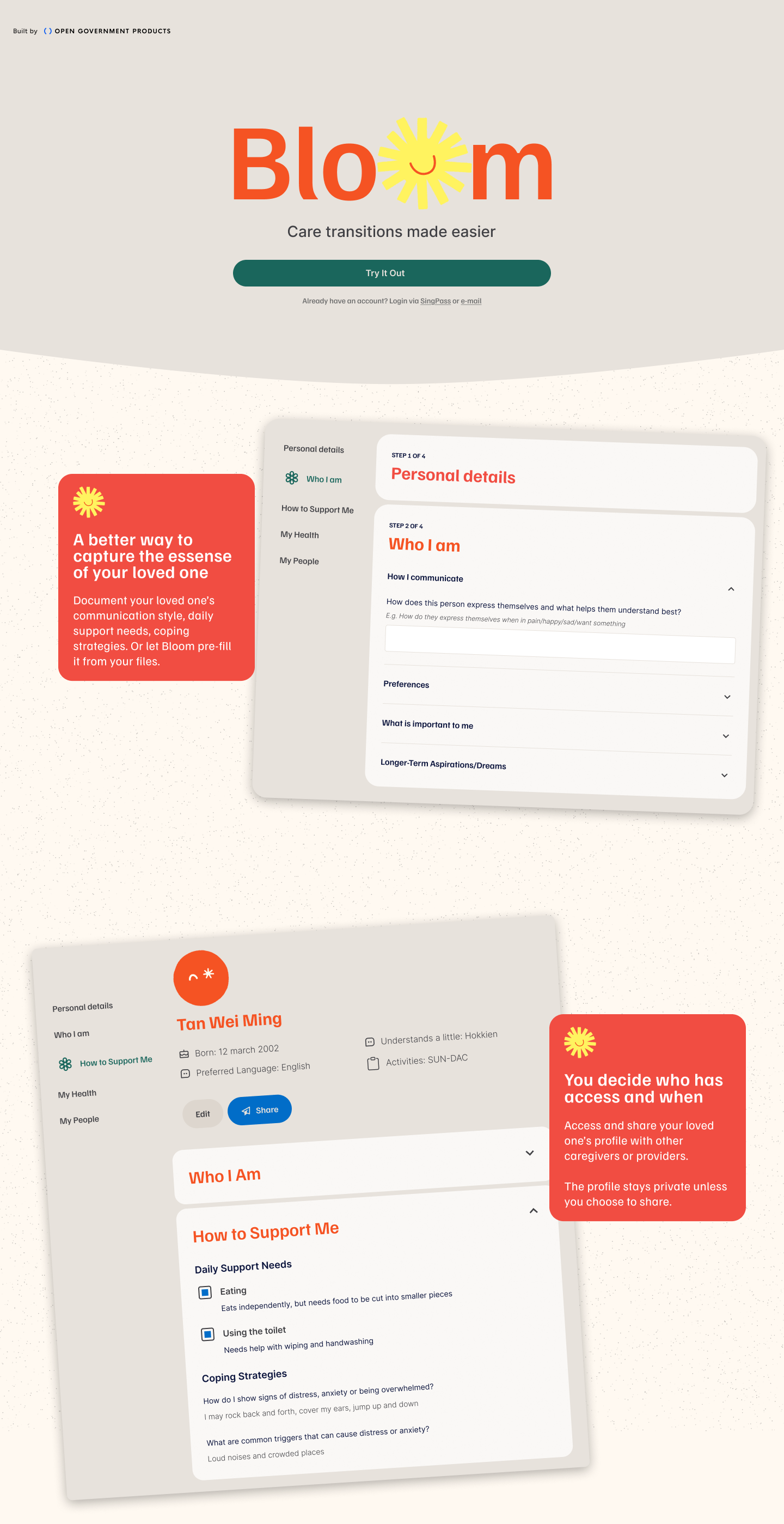
This is useful for:
Caregivers and families supporting an adult with moderate to severe intellectual and behavioural needs.
Service providers (including social workers, care coordinators and volunteers) supporting these individuals in DACs, community programmes, or clinics.
This is very useful. I wanted to create a handbook to pass it on as I am already 65, but don't know how to start.— Caregiver
…will be a useful point to start a conversation rather than (asking) what does he like…— Adult Disability Service Staff
Velocity and Traction
In the past month, we designed and built a working prototype of Bloom and tested it with caregivers and service providers.
4 out of 6 caregivers validated the need for a short and easy-to-maintain profile that can be shared across services
4 service providers shared that such a profile would be useful, with some expressing interest in piloting Bloom
Next, we plan to pilot Bloom with selected DACs and continue improving usability with a broader caregiver community.
Our Team
Special thanks to:
Caregivers and practitioners who have helped tremendously in research and user testing (HappeeHearts, SOSG, caregiver groups)
Insights and sharing from SPED schools (Rainbow Centre, MINDS)
Interested in piloting Bloom — as a caregiver, service provider, or organisation? Let us know your interest here or contact us at bloom@hack2026.com.sg